Ophthalmic lenses are prescription lenses that are designed to correct refractive errors of the eye, such as myopia (nearsightedness), hyperopia (farsightedness), astigmatism, and presbyopia. Their optical properties are determined by a prescription that an ophthalmologist or optometrist issues after an exam.
At KLAREVISION, we understand that seeing well means living better. That’s why we offer custom prescription eyeglasses for people of all ages who want to improve their vision and, in turn, their quality of life. With the support of our ophthalmologists in León, you’ll receive not only an accurate prescription but also personalized, expert care that guides you through the entire process.

Ophthalmic lenses are prescription lenses that are fitted into eyeglass frames to correct the way light enters the eye and focuses on the retina. Each refractive error produces a distinct focusing problem, and ophthalmic lenses address each one through a specific optical design.
occurs when the eyeball is slightly elongated, which causes light to focus in front of the retina rather than directly on it.
is the opposite condition, where the eyeball is shorter than normal and light focuses behind the retina.
is an age-related condition that typically becomes noticeable after age 40, when the natural lens of the eye loses elasticity and the ability to shift focus between near and distant objects.
results from an irregular curvature of the cornea or lens, which causes light to focus at multiple points rather than one, producing blurred or distorted vision at any distance.

An ophthalmic lens prescription is a clinical document that specifies the exact optical power required to correct each eye individually. It includes sphere power, cylinder power, axis, and addition power when presbyopia is present.
Even a small deviation in any of these values can result in lenses that fail to correct vision fully, induce distortion, or cause symptoms such as headaches, eye fatigue, and difficulty adapting to the lenses.
Precision matters since the visual system is highly sensitive. A difference of 0.25 diopters, which is the smallest increment in which prescriptions are written, is perceptible to many patients and can meaningfully affect visual comfort and clarity.
A professional eye exam is the only reliable method to obtain an accurate ophthalmic lens prescription. The process involves two complementary steps:
2. The second is a subjective refraction, in which the ophthalmologist presents the patient with a series of lens options and asks which produces clearer vision, a process that fine-tunes the prescription to the individual’s perception.
A comprehensive eye exam also evaluates the health of the anterior and posterior segments of the eye, which allows the specialist to detect conditions that can affect vision independently of refractive error.
This is the reason that an eye exam serves a dual purpose: it determines the correct lens and it screens for conditions that require medical or surgical attention beyond what any lens can address.
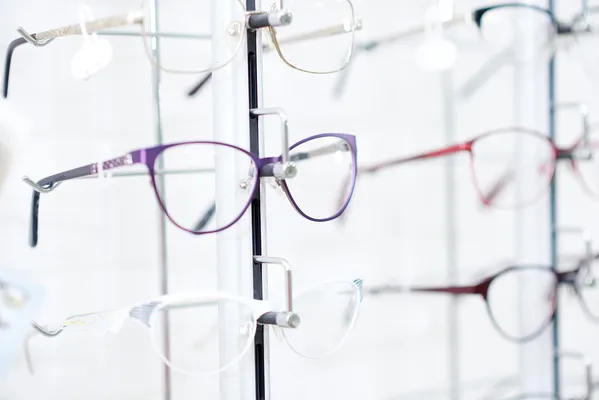
Each person’s visual system has specific characteristics that determine which lens type, design, and material will produce the clearest, most comfortable vision.
Choosing lenses without professional guidance frequently results in visual discomfort, incomplete correction, or lenses that are technically adequate but poorly suited to the patient’s daily activities and visual demands.
Find the right solution for you with us at KLAREVISION.